
文/環境權保障基金會
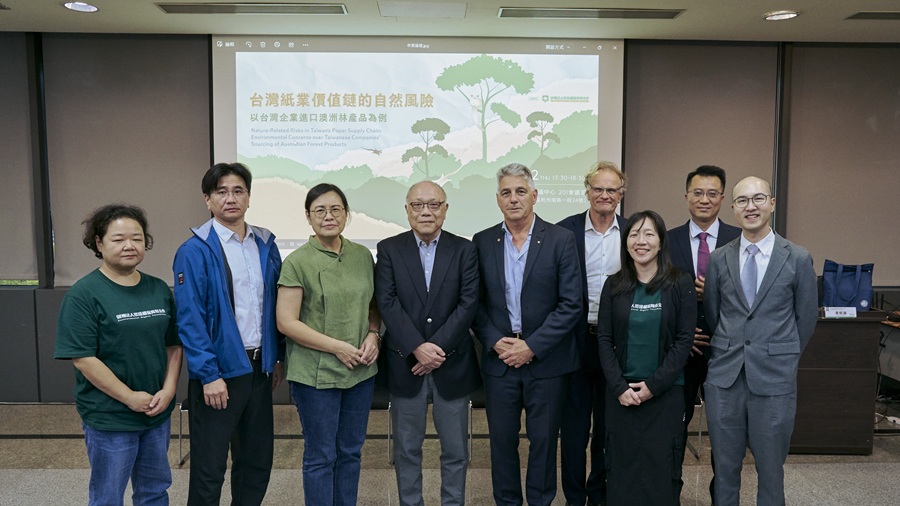
針對澳洲保育團體持續指出中華紙漿公司的原料採購,疑有部分涉及澳洲不當砍伐原生林之爭議,環境權保障基金會11/12下午一點半,邀請在國際責任投資領域聲譽卓著的澳洲投資家,亞洲投資人氣候變遷聯盟創辦人Mark Mills,以及今年剛榮獲美國國家科學院國際院士榮銜的澳洲自然保育學家 Prof. David Lindenmayer,舉辦「台灣紙業價值鏈的自然風險─以台灣企業進口澳洲林產品為例」公開論壇。向台灣公眾說明台灣紙業價值鏈的自然風險,以及對澳洲原生林砍伐議題的曝險程度,中華紙漿及永豐餘集團也出席論壇進行對話。
亞洲投資人氣候變遷聯盟創辦人創辦人Mark Mills,說明自然風險即金融風險。指出亞太區53%的經濟產出(約18兆美元)高度或中度依賴自然,台灣上市市值更有高達73%集中於自然依賴產業(其中44%為高度依賴),顯示如造紙等產業面臨顯著的供應鏈與生態風險。在自然流失加速及全球生物多樣性框架(TNFD等)法規趨嚴下,企業需獲得「社會營運許可」,投資人亦開始關注長期永續回報與自然氣候解方帶來的轉型契機。
澳洲國立大學教授 、美國國家科學院院士David Lindenmayer 根據近 30 年(1997–2025 年)的實地長期監測指出,澳洲東南部森林因大規模砍伐與碎裂化,老齡大樹與樹洞在 28 年間已減半(2035 年恐銳減 90%),重創大袋鼯、無尾熊等 303 種依賴樹洞的受脅物種。研究顯示,現有「責任木材」等驗證體系未能有效排除高保護價值林地伐木,且伐木後的新生林更易引發劇烈野火。講者呼籲應徹底退出天然林砍伐,全面轉向人工林以兼顧減碳與保育。
臺大森林系退休教授邱祈榮探討「目前森林驗證體系是否足夠」,指出過去十年全球仍流失了4,680萬公頃森林。面對氣候變遷與生物多樣性危機,國際對企業的規範正從早期自願性的「不毀林/零淨毀林」承諾,逐步演進為歐盟《零毀林法規(EUDR)》等具法律強制力的盡職調查義務,台灣企業必須強化供應鏈溯源與永續採購以因應綠色貿易門檻。
澳洲雨林資訊中心主席 Patrick Anderson 指出,台灣等國早於數十年前即禁止天然林商業伐木並轉向人工林,澳洲西澳與維多利亞州亦已跟進,唯獨新南威爾斯州國營林業公司仍持續砍伐原生林並屢遭罰款。他肯定環境權保障基金會與中華紙漿展開對話,指出中華紙漿採購政策雖排除瀕危與高保護價值林地,但澳方供應商卻未提供透明資訊。他呼籲台灣產業與民間共同發聲,拒買原生林木片並轉向人工林採購,以市場力量促使新南威爾斯州政府全面禁伐天然林。
主婦聯盟生活消費合作社常務理事許淑惠於主持對談時指出,每一次消費都是為想要的未來世界做選擇。面對台灣造紙原料可能涉及澳洲原生林不當砍伐、無意間將消費建立在遠方生態傷害上的問題,需要政府政策引導、嚴謹的第三方認證,以及企業落實負責任採購共同把關。合作社呼籲生產者與消費者攜手合作,透過負責任的生產與消費支持生態永續的林業採購,成為守護遠方原生林與瀕危物種的力量。
負責中華紙漿資材採購的永豐餘投資控股股份有限公司資材部協理詹家慶,代表於論壇中說明公司的木片採購政策與供應鏈管理機制。強調針對供應鏈溯源與風險控管,華紙已將包含產地經緯度在內的盡職調查(Due Diligence)要求納入招標規範與合約中,要求直接往來的貿易商確保上游集片商與林場提供詳實且可追溯的資料。若透過外部監督發現供應商有欺騙、隱匿或違法違規事實,華紙將祭出嚴厲合約處分,最重採取「不出貨(合約無效)」並限制其未來投標資格以達嚇阻之效。
中華紙漿黃鯤雄董事長於論壇總結中,分享自今年五月初與環境權保障基金會及澳洲團體就新南威爾斯木片議題接觸的歷程。黃董事長指出,他從原先認為澳洲供貨商為公營事業應屬合法合規,但在與Lindenmayer教授直接對話,並檢視其累積長期監測的大量資料後,便決定尊重科學證據。
為釐清真相,華紙要求供應鏈提供林班地圖與來源資料,並交由Lindenmayer教授進行判讀,確認當中確實有部分是來自高、中風險區域。黃董事長表示華紙採購政策本身沒有問題,問題在於企業較難100%掌握複雜供應鏈每一個關卡的細節,因此此次感謝公民團體與學者的建議,協助其了解更多數據資料與真相。他重申華紙絕不採購危害生物多樣性的木片,並承諾將於董事會上向所有董事傳達相同立場。
環境權保障基金會溝通與行銷總監黃尚卿表示,相當肯定中華紙漿與永豐餘集團自始保持開放態度,積極與台、澳團體溝通,並用心詳細檢視Prof.Lindenmayer 提供的長期監測資料,進而發現新南威爾斯地區採購的木片,確實存在與公司採購政策不一致的風險。這個過程,可說是台灣企業與利害關係人議和的典範案例,令人佩服。期盼中華紙漿與永豐餘集團,持續依照科學證據要求供應商必須確實遵守華紙本身已然有所規範的採購政策,中止供應有減損原生森林、高保護價值森林疑慮的林產品。
Respecting Scientific Evidence! Chung Hwa Pulp Confirms Ecological Risks in Some New South Wales Raw Materials, Commits to Not Purchasing Woodchips That Harm Biodiversity
TAIPEI, November 12, 2026 — In response to ongoing concerns raised by Australian conservation groups that raw material procurement by Chung Hwa Pulp Corporation (CHP) may partially involve the improper logging of native forests in Australia, the Environmental Rights Foundation (ERF) hosted a public forum at 1:30 PM on November 12 titled “Nature-Related Risks in Taiwan’s Paper Value Chain: The Case of Taiwanese Companies Importing Australian Forest Products.” The forum featured Mark Mills, founder of the Asia Investor Group on Climate Change (AIGCC) and a renowned figure in international responsible investment, alongside Prof. David Lindenmayer, an Australian conservation scientist newly elected as an International Fellow of the U.S. National Academy of Sciences this year. Aimed at explaining the nature-related risks in Taiwan’s paper value chain and its exposure to native forest logging in Australia, the event also welcomed representatives from Chung Hwa Pulp and YFY Inc. to engage in direct dialogue.
Mark Mills, Founder of the Asia Investor Group on Climate Change (AIGCC), explained that nature risk is financial risk. He noted that 53% of economic output in the Asia-Pacific region (approximately US$18 trillion) is highly or moderately dependent on nature, while a staggering 73% of Taiwan’s stock market capitalization is concentrated in nature-dependent industries (with 44% being highly dependent). This indicates that sectors such as papermaking face significant supply chain and ecological risks. Amid accelerating nature loss and tightening regulations under global frameworks like the Taskforce on Nature-related Financial Disclosures (TNFD), companies must secure a “social license to operate,” as investors increasingly focus on long-term sustainable returns and transition opportunities brought by nature-based climate solutions.
Prof. David Lindenmayer, Professor at the Australian National University and International Fellow of the U.S. National Academy of Sciences, cited nearly 30 years (1997–2025) of long-term field monitoring data showing that large-scale logging and habitat fragmentation in the native forests of southeastern Australia have halved the number of large old hollow-bearing trees over the past 28 years—with a projected 90% decline by 2035. This commercial logging, mainly for woodchips, severely threatens 303 hollow-dependent threatened species, including the Greater Glider and Koala. His research reveals blind spots in existing forest certification schemes such as “Responsible Wood,” which fail to effectively exclude logging in High Conservation Value (HCV) forests and threatened species habitats, while post-logging regrowth forests are far more prone to severe wildfires. He called for a complete exit from native forest logging and a full transition to plantation forestry to balance carbon reduction with ecological conservation.
Chyi-Rong Chiou, Retired Associate Professor from the School of Forestry and Resource Conservation at National Taiwan University, examined whether current forest certification systems are sufficient, noting that the world still lost 46.8 million hectares of forest over the past decade. Confronted with climate change and biodiversity crises, international corporate standards are evolving from early voluntary “no-deforestation / zero net deforestation” pledges toward legally binding due diligence obligations, such as the European Union Deforestation Regulation (EUDR). Taiwanese companies must strengthen supply chain traceability and sustainable sourcing to meet rising green trade barriers.
Patrick Anderson, President of the Rainforest Information Centre (Australia), pointed out that a dozen countries, including Taiwan banned commercial logging in native forests decades ago and transitioned to plantations, a move recently followed by Western Australia and Victoria. However, the state-owned Forestry Corporation of New South Wales (NSW) continues to log native forests despite repeated fines. Anderson commended ERF and CHP for engaging in dialogue, noting that while CHP’s procurement policy excludes endangered and HCV forests, its Australian suppliers have failed to provide transparent information. He urged Taiwanese industries and civil society to speak out together, reject native forest woodchips, and shift toward plantation sourcing to leverage market power in pushing the NSW government to end native forest logging.
Shu-Hui Hsu, Representative of the Taiwan Homemakers United Consumers Co-op, moderating the dialogue session, stated that every purchase is a vote for the future world we want to see. Addressing the issue that Taiwan’s papermaking raw materials may involve improper logging of Australian native forests—inadvertently linking everyday consumption to ecological harm afar—requires a combination of government policy guidance, rigorous third-party certification, and responsible corporate procurement. The co-op called on producers and consumers to join hands in supporting ecologically sustainable forestry sourcing through responsible production and consumption, becoming a force to protect distant native forests and endangered species.
Chia-Ching Chan, Associate Vice President of the Materials Department at YFY Inc., who is responsible for raw material procurement at Chung Hwa Pulp, outlined the company’s woodchip sourcing policies and supply chain management mechanisms. He emphasized that legal compliance is the baseline, and to ensure traceability and risk control, CHP has incorporated due diligence requirements—including geographic coordinates of harvest origins—into tender specifications and contracts. Direct trading partners are required to ensure that upstream chip mills and forest managers provide detailed, verifiable data. If external oversight uncovers deception, concealment, or illegal practices by a supplier, CHP will enforce strict contractual penalties, up to rejecting shipments (nullifying contracts) and suspending future bidding eligibility as a deterrent.
Kirk Hwang, Chairman of Chung Hwa Pulp, reflected in his closing remarks on his journey since first engaging with ERF and Australian groups in early May regarding NSW woodchips. Chairman Hwang shared that he initially assumed the Australian supplier, being a state-owned enterprise, would naturally operate legally and compliantly. However, after speaking directly with Prof. Lindenmayer and reviewing his extensive long-term monitoring data, he decided to respect the scientific evidence. To uncover the facts, CHP requested coupe maps and origin data from its supply chain and submitted them to Prof. Lindenmayer for assessment, confirming that some of the woodchips indeed originated from high- and medium-risk areas. Chairman Hwang stated that the issue lies not in CHP’s procurement policy itself, but in the company’s lack of 100% execution capability across multi-tiered supply chains, expressing gratitude to civil society groups and scholars for their assistance. He reaffirmed that CHP will never purchase woodchips that harm biodiversity and pledged to convey this exact stance to all board members at the company’s upcoming board meeting.
Annie Hwang, Communications and Marketing Director at the Environmental Rights Foundation, expressed strong appreciation for Chung Hwa Pulp and YFY Group for maintaining an open and positive attitude from the outset, actively communicating with Taiwanese and Australian groups, and thoroughly reviewing Prof. Lindenmayer’s long-term monitoring data—thereby identifying that woodchips sourced from New South Wales indeed carried risks of inconsistency with company sourcing policies. She noted that this process serves as a model case for stakeholder engagement in Taiwan, and expressed hope that CHP and YFY Group will continue relying on scientific evidence to require strict supplier compliance with CHP’s procurement policy and eliminate the supply of forest products that pose risks of degrading native or High Conservation Value forests.