
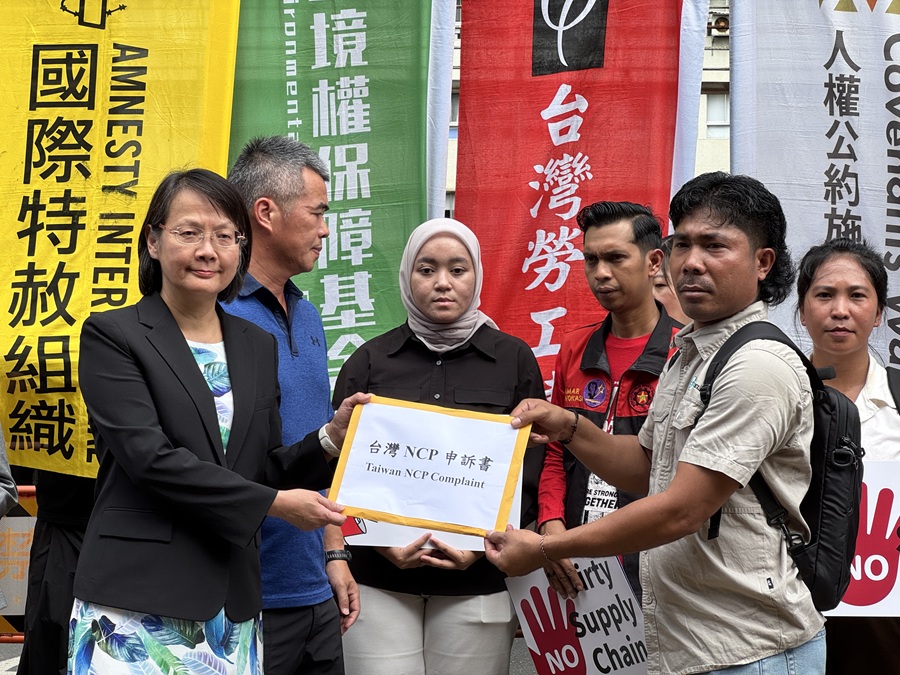
(經濟部代表接受台灣NCP申訴書)
文/環境權保障基金會
近年國際間對跨國供應鏈管理與人權盡職調查的要求日益嚴格。經濟合作發展組織(OECD)《多國籍企業指導綱領與責任企業行為》要求各國設立「國家聯絡點(National Contact Point, NCP)」,作為訴訟外的爭端解決與協調平台,協助企業降低營運風險並落實責任商業行為。
行政院已於2024年9月核定由經濟部擔任我國NCP,專責跨部會協調及企業侵害人權事件之申訴處理。但經濟部卻一拖再拖遲遲未公布相關受理流程跟運作機制。今天(9月1日)TTNC WATCH 成員-環境權保障基金會攜手印尼在地受影響社群與倡議團體,於今日正式向經濟部遞交台灣首件NCP申訴案。立法委員林月琴及關注企業人權團體也都出席聲援,呼籲政府啟動NCP機制,擅用NCP商議機制趁早協商、化解衝突。且面對當前錯綜複雜的國際地緣政治與經貿挑戰,台灣更應主動確保對外貿易與私部門投資具備高度韌性與永續性,落實負責任商業行為,防範人權與環境侵害風險,建立台灣產業的國際信譽。
環境權保障基金會顏士程律師說明環權會與印尼團體過去已兩度與被申訴企業議合,但直接議合的成效仍有不足,因此決定正式向經濟部提出申訴,要求經濟部依我國企業與人權政策及 OECD 指引,協助企業與受影響利害關係人進行有效議合並追蹤改善情形。顏士程律師指出,行政院早於2024年即已指定經濟部成立國家聯絡點(NCP),但至今申訴窗口及處理程序仍不明確,呼籲經濟部正式受理本案,使其從政策宣示走向實際運作。
對於印尼鎳礦開採影響長期關注的AEER的Titis,要求只要投資印尼子公司的母公司都應該嚴格落實人權盡職調查(HRDD),改善鎳產業高度依賴自備燃煤電廠(PLTU)的高碳排現況,並促進與在地社區利害關係人建立參與機制,提供申訴管道 。
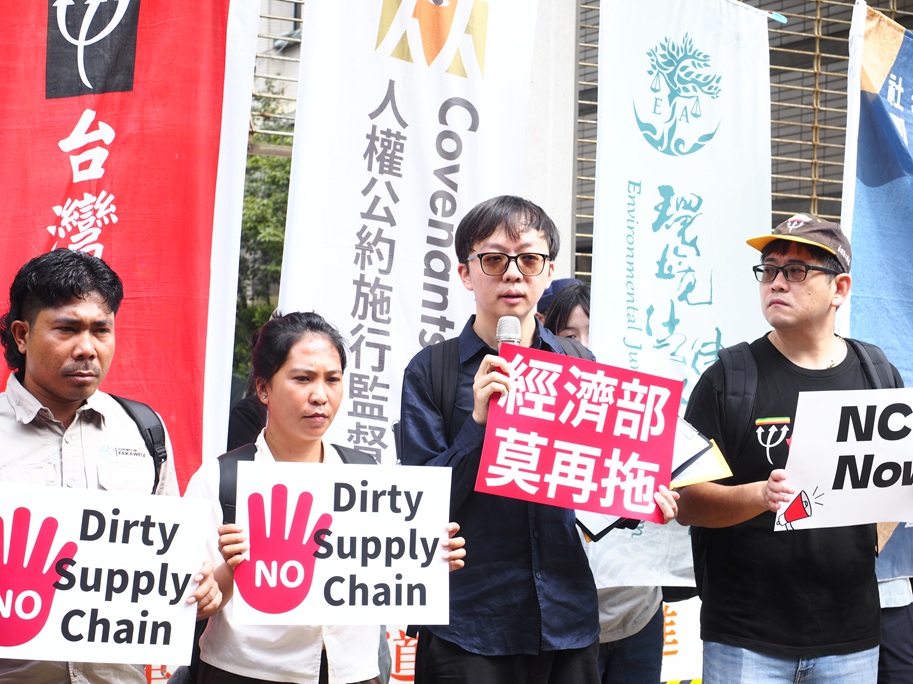
環境權保障基金會顏士程律師
莫羅瓦利園區工會聯盟 FSPIM 代表Amar 則說明此區勞工的處境, 尤其在混料廠房通風不良、集塵設備欠缺等問題,並提到「安德里(Andri)工傷事故」反映出進駐企業職安衛(K3)監管嚴重失職,同時要求改善冶煉爐作業區的個人防護裝備(APD)及接駁巴士等基本勞工福利。
Weda Bay當地組織 Fagawene 代表Yana則表達對於環境的重視,表示鎳礦開發與燃煤電廠廢水排放導致周邊珊瑚死亡、漁場遠移,加上森林濫伐引發洪患,已重創居民住宅區並使在地社群喪失乾淨飲用水來源。
Weda Bay的當地組織Fakawele代表Awal說明原來農地劃入Weda Bay鎳礦(Weda Bay Nickel)特許區後,薩蓋亞這邊的環境承受過多採礦特許權(IUP)的重擔 。大量採礦許可亦使薩蓋亞河湖生態及 Boki Maruru 溶洞等觀光資產面臨不可逆的破壞。
立法委員林月琴特別出席聲援表示,2022年及今年兩次兩公約國際審查,均要求臺灣建立NCP。她自去年8月與臺印民團召開記者會後書面追蹤,經濟部雖兩度回覆,卻始終沒有說清楚,國家如何積極確認案情,由誰收件,會如何處理,回覆中只有消極的對企業的加強宣導與溝通。她直言:「國際審查催了兩次,申訴人卻連門在哪裡都找不到。」現在權責已指定,相關研析報告也完成,林月琴指出,不能再以「仍在規劃」要求大家等待,她要求確認窗口、程序與期限,「不能讓NCP叫國家聯絡點,卻一直找不到能具題落實人權保障的收件點。」
台灣勞工陣線的楊書瑋秘書長強調,全球供應鏈的層層外包與跨境商業關係,常掩蓋強迫勞動等勞動人權侵害;企業責任不應僅止於「合規」,更須主動落實 OECD 倡導的人權盡職調查。 台灣作為全球供應鏈的重要一環,在臺美貿易協議及美國「301條款」的壓力下,政府雖已建立阻擋強迫勞動貨品的跨部會機制,但面對海外供應鏈侵害,台灣仍缺乏具實質功能、獨立公正的申訴與補救管道。政府應依循 OECD 準則落實「國家聯絡點」(NCP),並儘速更新延宕已久的「企業與人權國家行動計畫」,不只是因應國際貿易壓力,更是台灣從「被動接軌」走向「主動建立企業人權治理制度」的關鍵一步。
台灣人權促進會的施逸翔資深研究員提及早在 2011 年,經濟部投審會就曾因味王柬埔寨案派員赴海外調查並要求企業落實人權保障。15 年後的今天,當台灣政府以「企業與人權國家行動計劃」博得許多國際美名,還公告設立了NCP,那經濟部就更沒有理由拒絕此次申訴案,甚至要比2011的味王案更積極進行跨國事件調查與保障印尼在地社群的人權,和解決企業所造成的環境或人權侵害。施逸翔並強力呼籲,經濟部的第二版企業與人權行動計劃已經延宕了609天,其他因應巨大暫扣令案和台美對等貿易協定的政策,也持續推遲,如果NCP今天能正式受理並積極著手調查,至少主責企業人權責任的經濟部還能拿出一點可以對外說明的亮點,如果經濟部今天在這題還是擺爛,那只能證明經濟部根本就不想落實企業人權政策,就坦白跟社會大眾說明就好,不要浪費大家的時間。
發言_.jpg)
OLYMPUS DIGITAL CAMERA
主持人:環境權保障基金會凃又文執行長
發言順序:
1、顏士程律師 ( 環境權保障基金會 )
2、Titis (Action for Ecology and People Emancipation, AEER)
3、Amar ( FSPIM Morowali Labour union ) ( 印尼 Fakawele 社區居民代表 )
4、Yana ( Fagawene/Lelilef Sawai 社區居民代表 )
5、Awal ( 印尼 Fakawele 社區居民代表 )
6、林月琴立法委員
7、鄭中睿理事 ( 青年勞動九五聯盟 )
8、楊書瑋秘書長 ( 台灣勞工陣線 )
9、施逸翔資深研究員 ( 台灣人權促進會 )
– – – – – English Version – – – – –
PRESS RELEASE
Taiwan’s First OECD National Contact Point (NCP) Complaint Submitted to the Ministry of Economic Affairs
In recent years, international requirements for the management of transnational supply chains and human rights due diligence have become increasingly stringent. The OECD Guidelines for Multinational Enterprises on Responsible Business Conduct call for the establishment of National Contact Points (NCPs) as non-judicial mechanisms for dispute resolution and dialogue, helping enterprises reduce operational risks and implement responsible business conduct.
In September 2024, Taiwan’s Executive Yuan approved the designation of the Ministry of Economic Affairs (MOEA) as Taiwan’s National Contact Point, responsible for inter-ministerial coordination and for handling complaints concerning corporate human rights abuses. However, the MOEA has repeatedly delayed the announcement of the relevant procedures for submitting complaints and the mechanism for the NCP’s operation.
Today, September 1, the Environmental Rights Foundation, a member of TTNC WATCH, together with affected communities and advocacy groups in Indonesia, formally submitted Taiwan’s first complaint under the NCP mechanism to the Ministry of Economic Affairs.
Legislator Lin Yueh-chin, together with organisations concerned with business and human rights, also attended the press conference to express their support. The participating groups called on the government to activate the NCP mechanism and make effective use of the NCP’s good offices to facilitate early dialogue and negotiation and to resolve conflicts before they escalate.
Amid today’s increasingly complex geopolitical and economic challenges, Taiwan should take proactive steps to ensure that its external trade and private-sector investments are highly resilient and sustainable. By implementing responsible business conduct, preventing risks of human rights and environmental harm, and strengthening Taiwan’s industrial credibility, Taiwan can better safeguard its international reputation.
Environmental Rights Foundation: Previous Engagement with the Companies Has Been Insufficient
Attorney Yen Shih-cheng of the Environmental Rights Foundation explained that the Foundation and Indonesian organisations had previously engaged with the enterprises concerned on two occasions. However, the results of these direct engagements remained insufficient. The groups therefore decided to formally submit a complaint to the Ministry of Economic Affairs, requesting that the Ministry, in accordance with Taiwan’s business and human rights policies and the OECD Guidelines, assist the enterprises and affected stakeholders in carrying out effective engagement and follow up on subsequent improvements.
Yen pointed out that the Executive Yuan had designated the Ministry of Economic Affairs as Taiwan’s National Contact Point (NCP) as early as 2024. However, the channel for submitting complaints and the procedures for handling them remain unclear. He called on the Ministry to formally accept this case and move the NCP from a policy declaration to an operational mechanism.
AEER: Parent Companies Investing in Indonesian Subsidiaries Must Conduct Rigorous Human Rights Due Diligence
Titis of Action for Ecology and People Emancipation (AEER), who has long monitored the impacts of nickel mining in Indonesia, called on parent companies investing in subsidiaries in Indonesia to strictly implement human rights due diligence (HRDD).
Titis also called for improvements to the nickel industry’s highly carbon-intensive reliance on captive coal-fired power plants (PLTU). Companies should establish mechanisms for participation and engagement with local communities and other stakeholders, while also providing accessible channels for grievances.
FSPIM: Serious Concerns over Workers’ Occupational Safety and Health
Amar, a representative of the FSPIM Morowali Labour Union, described the situation faced by workers in the area, particularly problems including inadequate ventilation and the lack of dust collection equipment in ore-mixing facilities.
He also referred to the workplace accident involving Andri, saying that the incident reflected serious failures in the supervision of occupational safety and health (K3) among companies operating in the area.
Amar called for improvements to personal protective equipment (APD) for workers in smelting furnace operating areas, as well as basic labour welfare measures, including shuttle bus services.
Fagawene: Nickel Development Has Caused Serious Environmental Impacts
Yana, a representative of Fagawene, a local organisation in the Weda Bay area, expressed serious concerns about environmental impacts.
According to Yana, wastewater discharges associated with nickel mining and coal-fired power plants have led to coral death and forced fishing grounds further away from local communities. Meanwhile, extensive deforestation has contributed to flooding, severely affecting residential areas and depriving local communities of access to clean sources of drinking water.
Fakawele: Excessive Mining Concessions Threaten Local Ecosystems and Tourism Resources
Awal, a representative of Fakawele, a local organisation in the Weda Bay area, explained that after agricultural land was incorporated into the concession area of Weda Bay Nickel, the Sagea area has been placed under the burden of an excessive number of mining permits (IUPs).
The large number of mining permits has also placed the river and lake ecosystems in Sagea, as well as tourism resources such as the Boki Maruru Cave, at risk of irreversible damage.
Legislator Lin Yueh-chin: “International Review Bodies Have Urged Taiwan Twice, Yet Complainants Still Cannot Even Find the Door”
Legislator Lin Yueh-chin attended the press conference to express her support. She noted that both the 2022 and this year’s international reviews of Taiwan’s implementation of the two International Covenants on Human Rights had called on Taiwan to establish an NCP.
Since August last year, when she joined Taiwanese and Indonesian civil society groups in holding a press conference on the issue, Lin has continued to follow up with the Ministry of Economic Affairs in writing. Although the Ministry has responded twice, she said it has never clearly explained how the government will proactively ascertain the facts of a case, who is responsible for receiving complaints, or how complaints will be handled.
Instead, the Ministry’s responses focused only on relatively passive measures, such as strengthening outreach and communication with enterprises.
She stated:
“The international review bodies have urged Taiwan twice, yet complainants still cannot even find the door.”
Now that the responsible authority has been designated and the relevant research reports have been completed, Lin argued that the government can no longer continue asking stakeholders to wait on the grounds that the mechanism is “still under planning.”
She called for clear confirmation of the contact point, procedures and timelines.
“An NCP is called a National Contact Point, yet there must actually be a point of contact where complaints concerning the protection of human rights can be received and acted upon.”
Taiwan Labour Front: Corporate Responsibility Must Go Beyond Compliance
Yang Shu-wei, Secretary-General of the Taiwan Labour Front, emphasised that multiple layers of outsourcing and cross-border business relationships in global supply chains often conceal labour and human rights abuses, including forced labour.
Corporate responsibility should not stop at mere compliance. Enterprises must proactively implement the human rights due diligence advocated by the OECD.
As an important part of global supply chains, Taiwan has already established an inter-ministerial mechanism to prevent goods linked to forced labour from entering the market, in response to pressure arising from Taiwan–US trade relations and the United States’ Section 301 measures.
However, when it comes to human rights abuses occurring in overseas supply chains, Taiwan still lacks a grievance and remedy mechanism that is substantively functional, independent and impartial.
Yang called on the government to implement the National Contact Point (NCP) in accordance with the OECD Guidelines and to update Taiwan’s long-delayed National Action Plan on Business and Human Rights as soon as possible.
This is not merely a response to international trade pressure, he said, but a crucial step for Taiwan to move from “passive alignment” with international standards towards proactively establishing a system of corporate human rights governance.
Taiwan Association for Human Rights: The MOEA Must
Demonstrate Its Commitment to Business and Human Rights
Shih Yi-hsiang, Senior Researcher at the Taiwan Association for Human Rights, noted that as early as 2011, Taiwan’s Investment Commission under the Ministry of Economic Affairs had sent officials overseas to investigate the Wei Chuan Cambodia case and had required the company to strengthen its protection of human rights.
Fifteen years later, Taiwan has gained considerable international recognition for its National Action Plan on Business and Human Rights and has also announced the establishment of an NCP. Shih argued that the Ministry of Economic Affairs therefore has even less reason to reject the present complaint.
The Ministry should be even more proactive than it was in the 2011 case in investigating transnational corporate impacts, protecting the rights of affected communities in Indonesia, and addressing environmental or human rights harms caused by business activities.
Shih further criticised the continued delay in the release of the Ministry’s second National Action Plan on Business and Human Rights, which, he said, has now been delayed for 609 days. Other policies related to major Withhold Release Order cases and the Taiwan–US reciprocal trade agreement have also continued to be delayed.
“If the NCP formally accepts this case today and actively begins investigating the issues involved, at the very least the Ministry of Economic Affairs—which is responsible for business and human rights—will have something concrete to demonstrate to the public,” Shih said.
“If the Ministry of Economic Affairs continues to neglect this issue, it will only prove that the Ministry has no genuine intention of implementing Taiwan’s business and human rights policies. In that case, it should simply be honest with the public instead of wasting everyone’s time.”